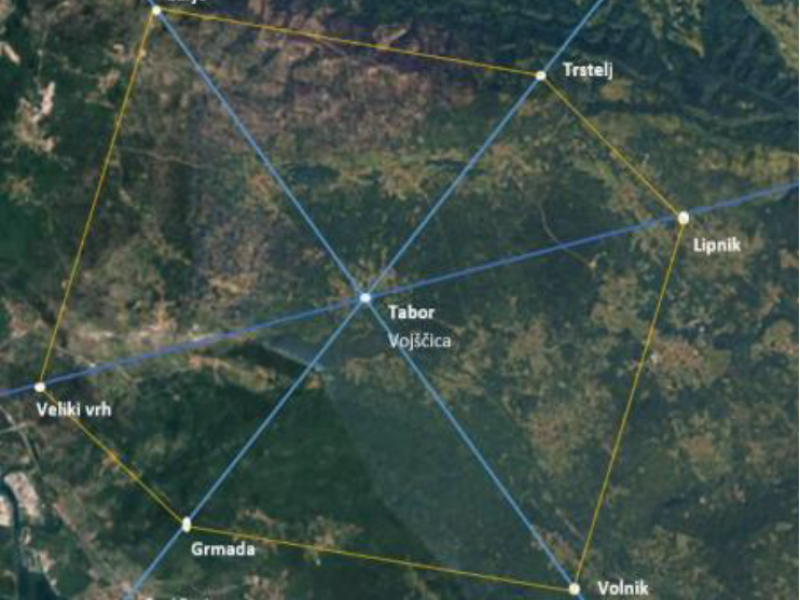
Geomantic Analysis of the Hillforts of Tabor, Grmača and Sant’Ambrogio
The geomantic analysis of the hillforts of Tabor (Vojščica), Grmača and Sant’Ambrogio, carried out within the framework of the Interreg VI-A Italy-Slovenia KAŠTellieri project, invites us to look at these protohistoric sites from a new perspective.
Not merely as defensive structures or archaeological remains, but as true key points within the Karst landscape: places selected over millennia not only for strategic reasons, but for their unique relationship with nature, natural resources, the morphology of the land and – according to geomantic interpretation – the energetic dynamics of space.
The study highlights how the three hillforts form an interconnected network:
• Tabor as a central hub and point of convergence,
• Grmača as a vital pole linked to water and the Karst underground,
• Sant’Ambrogio as an ancient sacred site and spiritual landmark.
Why is this important?
Because this research helps us understand that heritage is not merely a past to be preserved, but a living resource for the present. The hillforts can become spaces for education, responsible tourism, cultural enhancement and reflection on our relationship with the environment.
In an era marked by climate change and a growing distance from nature, rediscovering the deep bond between communities and landscape means strengthening identity, belonging and responsibility towards the territory.
The Karst hillforts are not just monuments: they are places that tell us who we were – and who we may become.
The document can be viewed at the following link: Geomantic Analyses